

latexmk3 صفحاتتجميع في 3.04 ث87.1 KB
قالب LaTeX: تقرير مختبر الفيزياء
تقرير مختبر علمي صارم بترويسة منسّقة وقسمي الفرضية والمنهجية ومخطط تبعثر بأشرطة خطأ pgfplots ووحدات النظام الدولي عبر siunitx وجدول نتائج منظَّم.
\source{lab-report}
\documentclass[12pt]{article}
\usepackage[margin=1in]{geometry}
\usepackage{amsmath}
\usepackage{booktabs}
\usepackage{siunitx}
\usepackage{pgfplots}
\usepackage{float}
\usepackage{caption}
\usepackage{xcolor}
\usepackage{tcolorbox}
\usepackage{tikz}
\usepackage{colortbl}
\usepackage{fancyhdr}
\usepackage{hyperref}

\pgfplotsset{compat=1.18}
\sisetup{separate-uncertainty=true}
\tcbuselibrary{skins}

\definecolor{labblue}{HTML}{1D4ED8}
\definecolor{labbg}{HTML}{EFF6FF}
\definecolor{rowalt}{HTML}{F0F9FF}

\hypersetup{colorlinks=true,linkcolor=labblue}

\pagestyle{fancy}
\fancyhf{}
\fancyhead[L]{\small\textcolor{gray}{<<course_name>>}}
\fancyhead[R]{\small\textcolor{gray}{<<student_name>>}}
\fancyfoot[C]{\thepage}
\renewcommand{\headrulewidth}{0.4pt}

\newtcolorbox{labsection}[1]{
  colback=labbg, colframe=labblue!60, coltitle=white,
  fonttitle=\bfseries\small, title={#1},
  attach boxed title to top left={yshift=-2mm,xshift=6mm},
  boxed title style={colback=labblue, rounded corners},
  before skip=10pt, after skip=6pt,
}

\begin{document}

% --- Header ---
\begin{tikzpicture}[remember picture,overlay]
  \fill[labblue] (current page.north west) rectangle ([yshift=-2.2cm]current page.north east);
\end{tikzpicture}
\vspace*{0.3cm}
\begin{center}
  {\LARGE\bfseries\textcolor{white}{<<experiment_title>>}}\par
  \vspace{6pt}
  {\normalsize\textcolor{white!80}{<<course_name>>  \quad|\quad  <<student_name>>  \&  <<lab_partner>>}}\par
  \vspace{4pt}
  {\small\textcolor{white!70}{Instructor: <<instructor>> \quad Date: <<date_performed>>}}
\end{center}
\vspace{1.8cm}

\begin{labsection}{Objective}
To determine the local gravitational acceleration $g$ by measuring the period of a simple pendulum at various lengths and comparing the result with the accepted value of $g = \SI{9.81}{m/s^2}$.
\end{labsection}

\begin{labsection}{Theory}
For a simple pendulum with small angular displacement ($\theta < 15°$), the period $T$ is:
\begin{equation}
  T = 2\pi\sqrt{\frac{L}{g}}
\end{equation}
where $L$ is the length of the pendulum and $g$ is the gravitational acceleration. Squaring both sides:
\begin{equation}
  T^2 = \frac{4\pi^2}{g} L
\end{equation}
This is linear in $L$. The slope $m = 4\pi^2/g$, so $g = 4\pi^2/m$.
\end{labsection}

\begin{labsection}{Materials and Methods}
\begin{itemize}
  \item Steel bob ($m = \SI{50.0 \pm 0.1}{g}$)
  \item Nylon string ($L$ varied from \SI{0.40}{m} to \SI{1.20}{m})
  \item Digital stopwatch (resolution: \SI{0.01}{s})
  \item Meter stick (resolution: \SI{1}{mm})
\end{itemize}
For each length, 10 full oscillations were timed and repeated 3 times. The period was computed as $T = t_{10}/10$, with uncertainty from the standard deviation of trials.
\end{labsection}

\begin{labsection}{Data}
\begin{table}[H]
  \centering
  \caption{Pendulum period measurements at various lengths.}
  \label{tab:data}
  \begin{tabular}{S[table-format=1.2] S[table-format=1.3] S[table-format=1.3] S[table-format=1.3]}
    \toprule
    \rowcolor{rowalt}
    {$L$ (\si{m})} & {$T$ (\si{s})} & {$\delta T$ (\si{s})} & {$T^2$ (\si{s^2})} \\
    \midrule
    0.40 & 1.268 & 0.008 & 1.608 \\
    0.60 & 1.553 & 0.010 & 2.412 \\
    0.80 & 1.795 & 0.012 & 3.222 \\
    1.00 & 2.007 & 0.009 & 4.028 \\
    1.20 & 2.198 & 0.011 & 4.831 \\
    \bottomrule
  \end{tabular}
\end{table}
\end{labsection}

\begin{labsection}{Analysis}

\begin{figure}[H]
  \centering
  \begin{tikzpicture}
    \begin{axis}[
      width=0.75\textwidth,
      height=8cm,
      xlabel={Length $L$ (\si{m})},
      ylabel={$T^2$ (\si{s^2})},
      xmin=0.3, xmax=1.3,
      ymin=1, ymax=5.5,
      grid=major,
      legend pos=north west,
    ]
      \addplot[only marks, mark=*, mark size=2.5pt, labblue] coordinates {
        (0.40, 1.608)
        (0.60, 2.412)
        (0.80, 3.222)
        (1.00, 4.028)
        (1.20, 4.831)
      };
      \addplot[red!70!black, thick, domain=0.3:1.3] {4.028*x - 0.003};
      \legend{Data, Linear fit}
    \end{axis}
  \end{tikzpicture}
  \caption{$T^2$ vs.\ $L$ with linear regression. Slope $m = \SI{4.028 \pm 0.045}{s^2/m}$.}
  \label{fig:t2-vs-l}
\end{figure}

From the slope of the linear fit:
\[ g = \frac{4\pi^2}{m} = \frac{4\pi^2}{4.028} = \SI{9.80}{m/s^2} \]

Using standard error propagation on $g = 4\pi^2/m$:
\[ \delta g = g \cdot \frac{\delta m}{m} = 9.80 \times \frac{0.045}{4.028} = \SI{0.11}{m/s^2} \]

\textbf{Final result:} $g = \SI{9.80 \pm 0.11}{m/s^2}$
\end{labsection}

\begin{labsection}{Discussion}
Our measured value of $g = \SI{9.80 \pm 0.11}{m/s^2}$ agrees with the accepted value of \SI{9.81}{m/s^2} within experimental uncertainty. The percent error is:
\[ \%\text{error} = \frac{|9.81 - 9.80|}{9.81} \times 100\% = 0.10\% \]
Sources of systematic error include air resistance (which would increase the measured period and decrease the computed $g$) and the finite size of the bob. The small angle approximation is valid since all swings were initiated at $\theta \approx 10°$.
\end{labsection}

\begin{labsection}{Conclusion}
The gravitational acceleration was determined to be $g = \SI{9.80 \pm 0.11}{m/s^2}$, consistent with the accepted value. The linear relationship between $T^2$ and $L$ confirms the simple pendulum model for small oscillations.
\end{labsection}

\end{document}
Source requires Pro
latexmk templates are available on the Pro plan and above.
See the compiled PDF
No API key required
\usepackage{used}
حزم LaTeX المستخدمة
\geometryهوامش الصفحة والتحكم في التخطيط
\amsmathبيئات وأوامر رياضية متقدمة
\booktabsتنسيق جداول بجودة احترافية
\siunitxوحدات النظام الدولي وتنسيق الأرقام
\pgfplotsرسم البيانات والدوال الرياضية
\floatتحكم أفضل في موضع العناصر العائمة
\captionتنسيق تعليقات الأشكال والجداول
\xcolorتعريف الألوان واستخدامها
\tcolorboxصناديق نصية ملوّنة ومؤطرة
\tikzرسم المخططات والرسومات المتجهة
\colortblصفوف وأعمدة جداول ملوّنة
\fancyhdrترويسات وتذييلات مخصصة
\hyperrefالروابط التشعبية والبيانات الوصفية لملفات PDF
\begin{tabular}
متغيرات القالب
| المتغير | النوع | القيمة الافتراضية | الوصف |
|---|---|---|---|
| experiment_title | string | Determination of Gravitational Acceleration Using a Simple Pendulum | Experiment title |
| course_name | string | PHYS 201 --- Classical Mechanics Lab | Course name and code |
| student_name | string | Jordan Lee | Student name |
| lab_partner | string | Taylor Kim | Lab partner name |
| date_performed | string | February 18, 2026 | Date experiment was performed |
| instructor | string | Dr.~Marcus Webb | Lab instructor name |
\section{related}
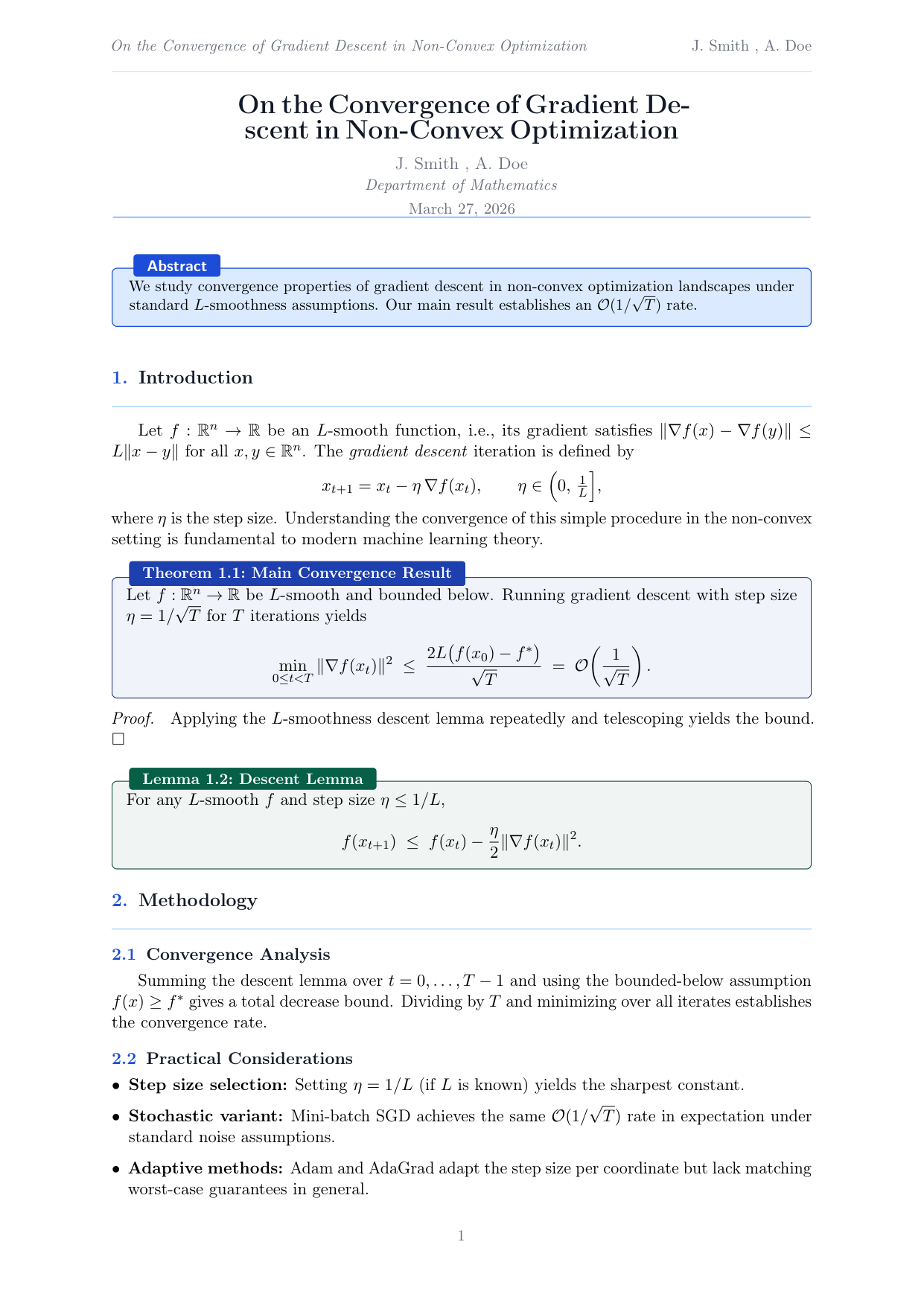
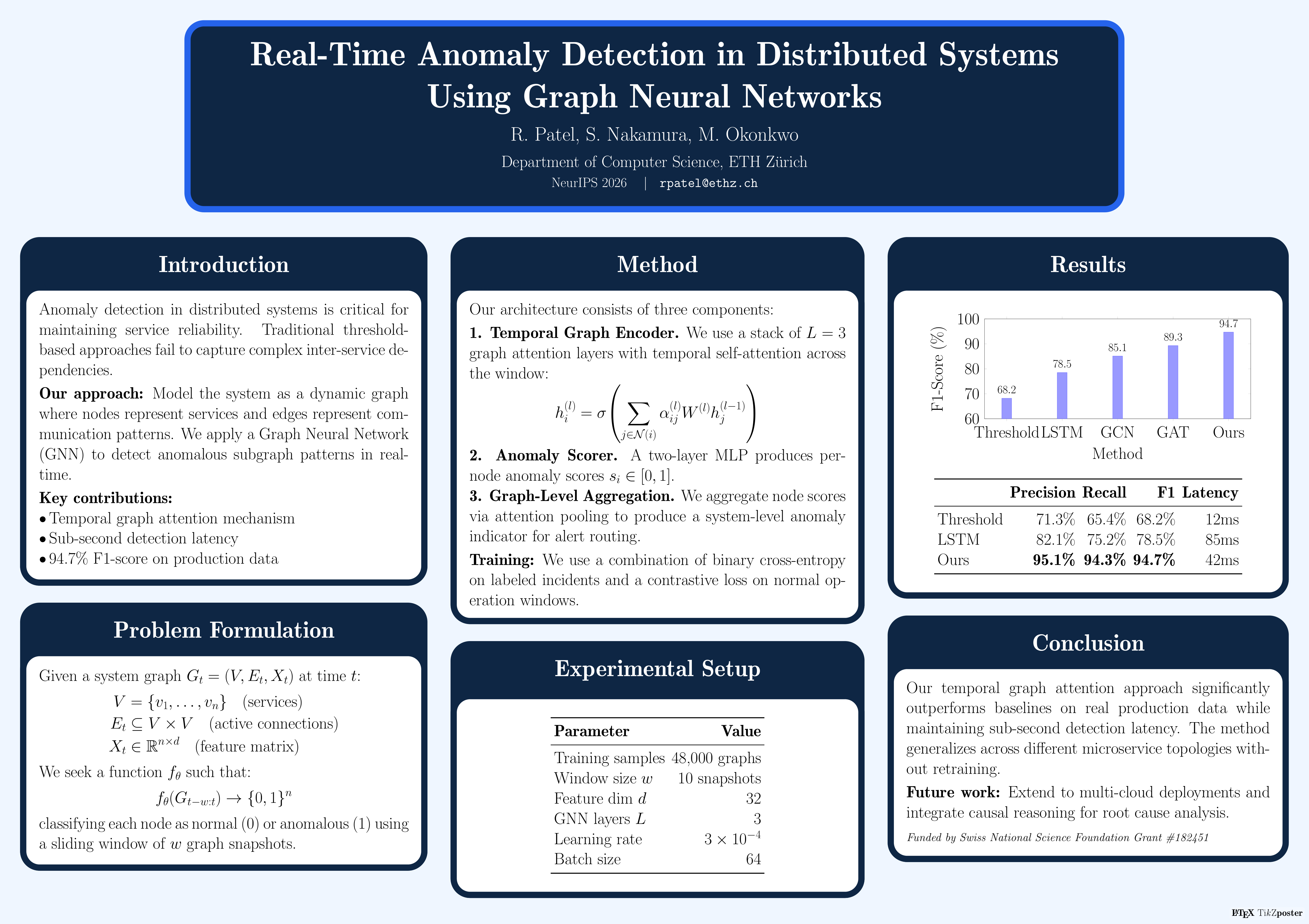
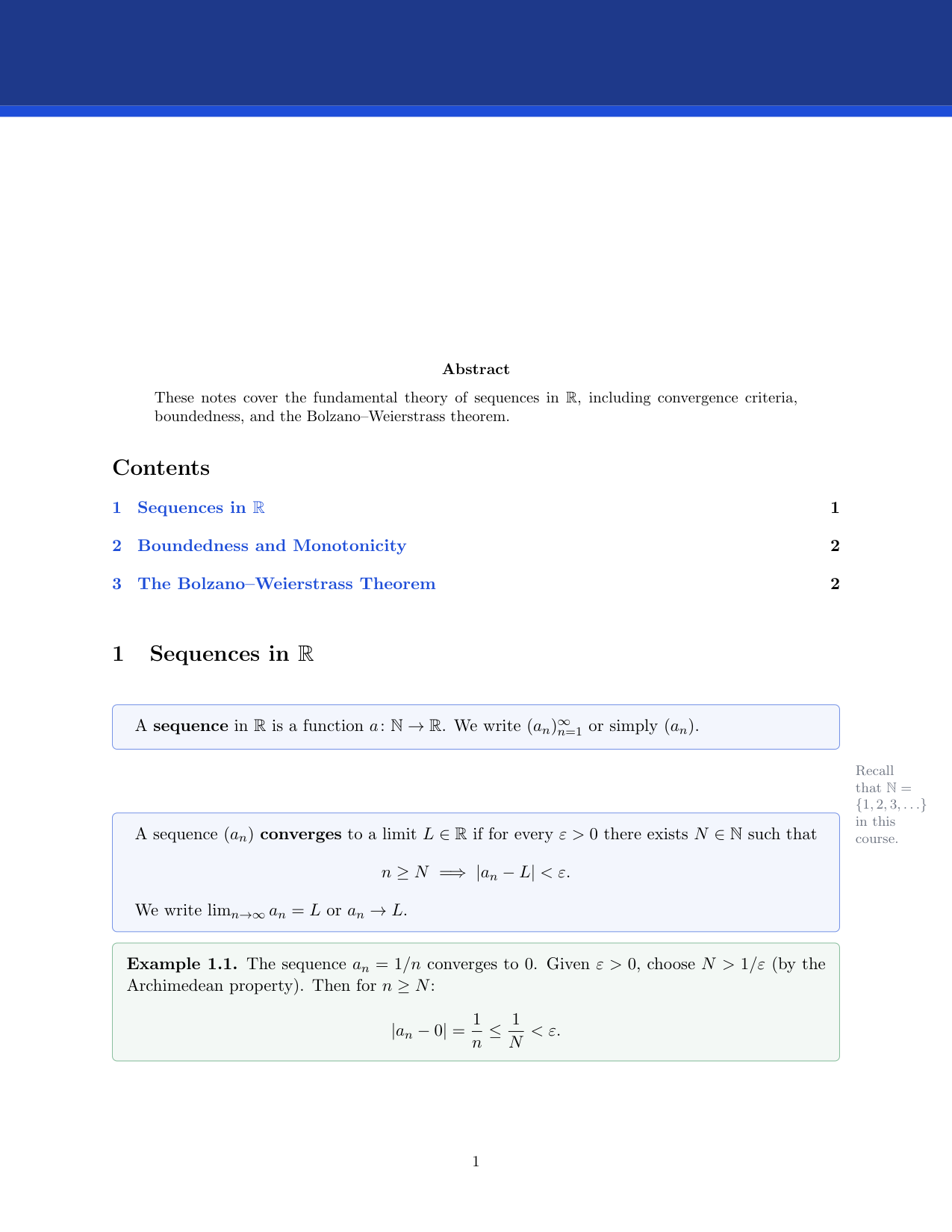
المزيد من قوالب فئة Academic

\compile{instantly}
خصّص وجمّع فورًا
حمّل هذا القالب في الـ playground وعدّله وشاهد ملف PDF الخاص بك خلال ثوانٍ.